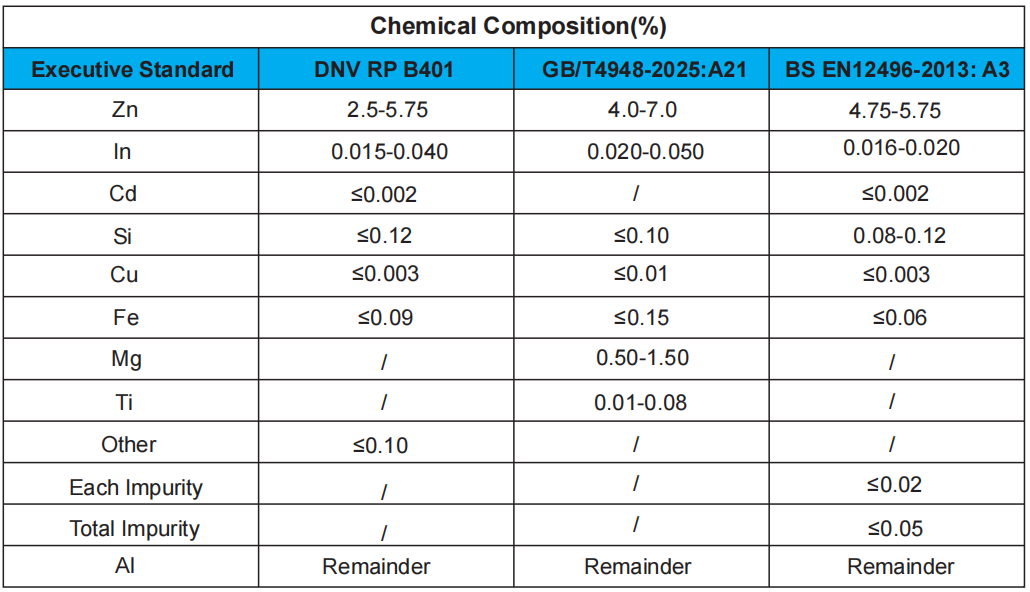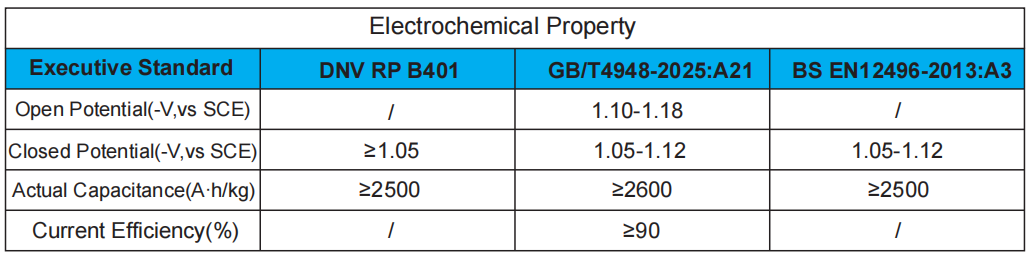



Condenser aluminum anodes typically utilize an Al–Zn–In activating formulation (with trace additions of Sn/Cd/Mg). They function by forming and maintaining an activatable surface in seawater/brackish water, operating at a stable potential of approximately –1.05 to –1.10 V (vs.CSE) as a sacrificial anode.
Condenser aluminum anodes typically utilize an Al–Zn–In activating formulation (with trace additions of Sn/Cd/Mg). They function by forming and maintaining an activatable surface in seawater/brackish water, operating at a stable potential of approximately –1.05 to –1.10 V (vs.CSE) as a sacrificial anode. Through micro-cell current, they polarize carbon steel tube sheets/water chambers into the protective range, mitigating pitting and crevice corrosion. Characterized by high capacitance, low density, and high output per unit mass (lightweight), they are well-suited for seawater/brackish water cooling systems with high conductivity, enabling efficient multi-point deployment and long-term maintenance for large-scale condensers.
KEY FEATURES
SPECIFICATIONS